AINews wire, 8 h ago
Homelab builder links four used V100 GPUs to a mini PC for 128GB of VRAM
Reported by Tom's Hardware
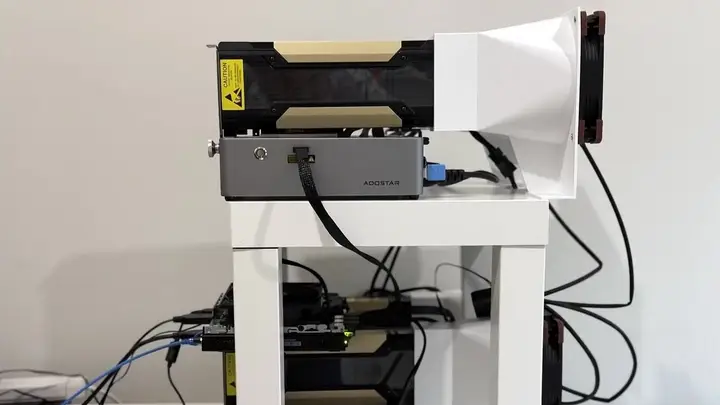
A homelab builder has put four used Nvidia Tesla V100 cards, each with 32GB of memory, into a small Lenovo desktop. The result is a local AI machine with 128GB of video memory in total. Tom's Hardware reported the build on 23 November 2026, based on a Reddit post and a video guide by the builder, who goes by Michael and lives in Australia.
The base is a refurbished Lenovo M720q Tiny with an i5-9400T processor and 64GB of DDR4 memory. The GPUs connect over four OCuLink cables from a PCIe switch card, so each card runs at PCIe Gen3 x4. Getting the system to work needed several changes. The riser slot only powered up when the card signalled a presence pin, which the switch card did not, so the builder added a solder bridge. The stock BIOS allowed a 128GB memory window for 64-bit devices, enough for only two V100s, because each card needs 64GB. He flashed coreboot with an EDK2 payload and an above-4G setting, which widened the window to about 486GB. Flashing needed a CH341A programmer and a SOIC8 clip.
Each V100 sits in an AOOSTAR AG01 eGPU dock with its own 800 W power supply. The cards need a CPU 8-pin connector, so he used a dual PCIe 8-pin to CPU/EPS adapter for each one. The V100s are passively cooled. He fitted each with a 3D-printed 140 mm funnel and a Noctua fan, and all four fans run from one USB fan controller. A separate fan cools the switch card, which runs hot. He measured the noise at about 62 dB from one metre. A script stops work when the hottest card reaches 83°C and shuts the system down at 87°C. Each card is capped at 200 W, or 800 W in total.
The builder reports 44.7 TFLOPS in FP32 with a peak temperature of 71°C across the four cards. Nvidia rates each 250 W card at 14 TFLOPS. He compares the set with a single RTX 5090, which is rated at 104.8 TFLOPS at 575 W. He says the four V100s give four times the VRAM and about twice the total memory bandwidth of one 5090, at about half its price in Australia. These figures come from the builder and have not been independently tested.
He reports that Qwen3.8-27B Q6 reaches about 40 tokens per second on one card and about 285 tokens per second across all four. Each card runs its own copy and handles four requests at once. A larger model, Qwen3.8-Flash-Next-125B-A6B IQ4_XS, reaches about 43 tokens per second in chat across all four cards, or about 116 with eight requests. These speeds are the builder's own measurements.
He gives the total cost as about A$6.5k including local taxes, which he puts at close to $3,500 US. He says the PCIe cards rose in price in recent months. He uses the system for work, processing decades of stock-announcement data for his business, and says it has run almost constantly for a few weeks. He expects it to pay for itself in about three months. He chose PCIe cards over SXM2 modules to keep noise down and because they cost less. He plans to benchmark other inference tools and may add a second set of four cards.
Several points remain open. The payback estimate and the speed claims are the builder's own. The long-term stability of the build has not been independently checked, and the source's cost table was not part of the text we received.
Enjoying this? Get the AI brief
Every Thursday: AI that matters for your home.
✓ Free · seven editions · one click to leave
Original reporting by the sources above. Summary by smart-home.space.