EV & MobilityNews wire, 3 h ago
Tesla starts rolling out FSD v15 with fixes for signs, potholes and school zones
Reported by Electrek
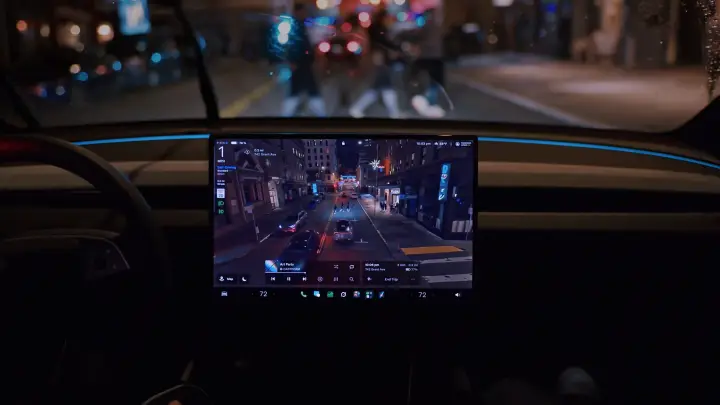
Tesla has begun rolling out version 15 of its Full Self-Driving software, according to Electrek, which reviewed the company's announcement and release notes. The update targets known weak spots: road sign detection, potholes and speed handling in school zones. Tesla also says a new vision encoder improves the critical intervention rate by 25 times. The company has not said which vehicles will receive v15 first, but it has told investors that its AI4 (HW4) computer can run the software.
The release notes list several other changes. Detection of road signs, small animals, road debris and tyre chains is said to be better. Potholes and deep standing water should be handled more reliably. Speed handling is adjusted for each driver profile, school zones, speed limits and bad weather. Autoshift now uses the same gear predictions as FSD. FSD will also slow down for speed cameras, and a new Bike Rack Mode supports driving with a bike rack or similar hitch accessory. Parking selection draws on each driver's parking history, and the map can show several parking options at a destination. Navigation learning, which uses route preference data from the fleet, currently covers only the start and end of trips. Tesla says later releases will extend it to the full route.
The most visible change is a new visualisation. Tesla calls it Reality View in its announcement and Tesla Augmented Reality in the notes. It shows a detailed, rendered view of the street around the car on the centre screen. The notes say it replaces the separate model signals with one end-to-end view that needs less compute, and that drivers can see and control what FSD plans to do. Driver monitoring moves the other way in one respect: attention checks will work with hats and sunglasses more often, and strictness is reduced in higher-speed driver profiles. Tesla is tightening monitoring in Europe at regulators' request, so this change stands out.
Electrek points to where Tesla is focusing. In a September test published by the Brussels nonprofit Johanna.be, FSD exceeded the limit in 55% of the 30 km/h zones it drove through, averaging 44 km/h. In most of those zones the car's screen showed a 50 km/h limit, meaning the sign was not read. Musk said in August that pothole avoidance was coming soon, a promise he first made in 2019, and Electrek notes that FSD still drives through potholes. US safety regulator NHTSA is reviewing a petition that says Tesla's robotaxis speed through active school zones. It also has an investigation, opened in October 2025, into FSD traffic-law violations such as running red lights.
The 25x figure refers to the critical intervention rate, which Electrek calls the right metric for progress toward unsupervised driving. Tesla has not published the underlying number, only the multiplier. Electrek's own earlier data suggested FSD v14 could go a couple of thousand miles between critical interventions. On that basis, a 25-fold gain would imply about 50,000 miles, well above the roughly 10,000 miles Electrek has said Tesla needs for a limited unsupervised service. This is Electrek's estimate, not Tesla's. In April Musk wrote that v15 would exceed human safety levels even in unsupervised and complex situations. Electrek notes he made similar claims for v12 and v14. In August Tesla told JPMorgan that v15 is a step change built on seven core technologies, roughly 40 percent of which already run in its Austin robotaxi fleet.
FSD has improved unevenly. When v14 arrived in October 2025 it brought hallucinations, aggressive braking and excessive speeding. Early crowdsourced figures put the average distance before a critical disengagement near 732 miles, below what Electrek expected. Performance then improved, but the v14.2 updates went backward before Musk presented v14.3 as the version that completed the work. Seven months and many point releases later, owners still supervise the system. Electrek says the visuals can already be judged from the video, while the driving gains cannot yet be verified. Tesla has not published the disengagement data that would settle the question, and it is unclear how quickly the changes will reach owners.
Enjoying this? Get the EV & Mobility brief
Every Wednesday: charging, cars and costs.
✓ Free · seven editions · one click to leave
Original reporting by the sources above. Summary by smart-home.space.