EnergyNews wire, 23 Nov 2026
Massachusetts solar program returns $1.49 in ratepayer benefits per dollar
Reported by pv magazine USA
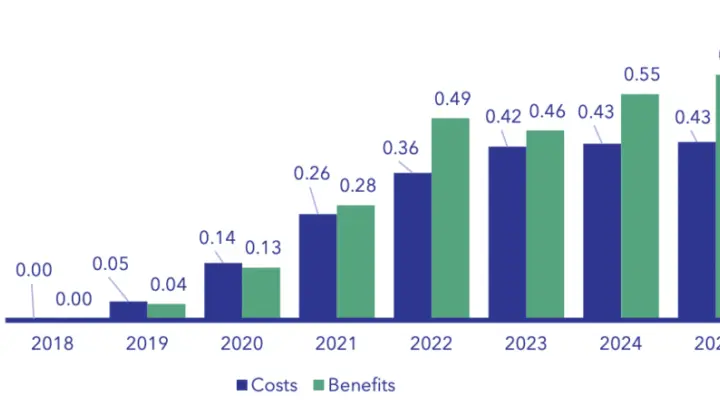
A Massachusetts state report finds that its flagship solar incentive, the Solar Massachusetts Renewable Target (SMART) program, returns an estimated $1.49 in direct ratepayer benefits for every dollar spent. The October study was prepared by the Department of Energy Resources, and pv magazine USA reported it on 23 November 2026.
Two consulting firms supported the work. Researchers examined roughly 1.9 GW of solar capacity installed from 2018 through 2025, including projects combined with battery storage. Each installation was modeled over an assumed 25-year operating life. Monetary values are given in 2024 dollars.
Over their projected lifetimes, SMART projects are expected to deliver $11.5 billion in benefits against $7.7 billion in costs, a projected gain of $3.8 billion. In 2025 alone, the projects are estimated to have produced $590 million in benefits and $430 million in costs. Including other solar installations in the study, lifetime benefits total an estimated $14.4 billion. Costs for that group are put at $11.1 billion.
For a typical household served by an investor-owned utility, the studied programs cut electricity bills by an average of $9 a year between 2018 and 2025. Savings reached $26.10 per household in 2025, up from $18.78 in 2024. These figures count only effects on electricity rates. They leave out avoided emissions, public health gains and local jobs.
SMART pays developers based on how much power their projects generate. The first two program versions supported about 1.39 GW through 2025. Around 40% of capacity is paired with batteries, which the researchers link to cost-effectiveness.
Batteries help shift output to peak demand periods. The study also credits avoided power purchases and grid upgrades, which together make up 49% of direct benefits.
Renewable energy certificates add value. Utilities own them and may use them for renewable targets or sell them to offset costs. Resale accounts for 9% of estimated direct benefits.
Net metering projects outside SMART are less cost-effective, returning about $0.90 per dollar spent. Energy compensation makes up 79% of program costs.
Utility Eversource disputes parts of the study. Its October 16 letter to lawmakers questions the assumed grid savings and battery discharge.
The study does not cover SMART 3.0, which began taking applications in October 2025.
Enjoying this? Get the Energy brief
Every Friday: prices, subsidies and what changed in your market.
✓ Free · seven editions · one click to leave
Original reporting by the sources above. Summary by smart-home.space.