AINews wire, Yesterday
A 97 KB browser demo shows Claude Fable 5.2 building a full underwater scene
Reported by XDA Developers, Tom's Hardware
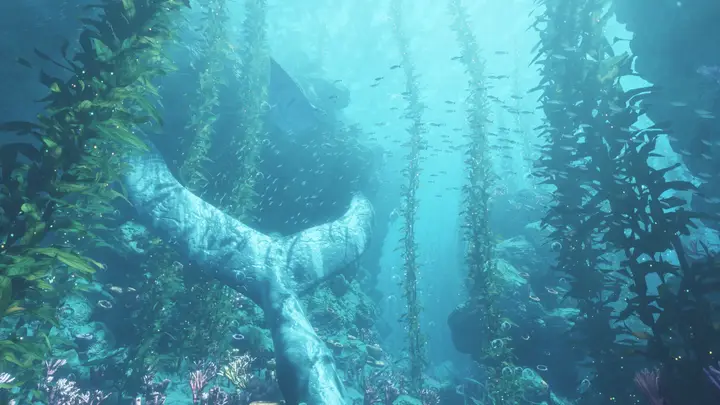
A front-end developer used Claude Fable 5.2 to build a small interactive underwater world that runs in a web browser. The project, called Abyssal Garden, is a single HTML file. The reports differ slightly on its size: XDA Developers gives 97 KB, while Tom's Hardware gives 96 KB.
XDA Developers says the project was shared by a Reddit user, Any-Reputation8118, on the ClaudeAI subreddit. Tom's Hardware names the developer as Maksymilian Dendura. Both reports describe the same project and say it started from one prompt.
According to XDA Developers, the scene includes seaweed forests, a wreck, a stone sculpture of a whale's tail, rays and shoals of fish, and beams of light from the surface. Tom's Hardware says the 3D space and textures are procedurally generated, meaning they come from mathematical formulas rather than prebuilt models, and are calculated when the page loads. Both reports say the file has no images, 3D models, sound files or libraries.
Both outlets say Claude wrote the code. XDA Developers reports that later prompts asked the model to add a menu, collision handling and quality controls. It also says Claude checked its own output for visual faults. Tom's Hardware notes that the original prompt is short, about 40 lines with word wrapping, and that the author probably made some manual adjustments.
Tom's Hardware reports that the author gets 180 frames per second at 1440p on an RTX 5070 Ti. The outlet also notes that an X user later reduced the file to 52 KB. The scene relies on WebGPU and WebGL, two browser graphics interfaces.
Tom's Hardware places the work in the demoscene, a tradition of tiny programs that produce graphics and sound, which goes back to the 1980s. It cites earlier examples: a 2009 demo of just under 4 KB with music, and .kkrieger, a 2004 first-person shooter prototype in 96 KB. The outlet calls the agent's autonomy the main achievement. It also notes that demos offer little interaction, logic or physics compared with a full game.
What the reports do not make clear is how much manual tweaking the author did, or whether the scene runs the same way in every browser and on every graphics card. The original prompt is shared in the project's GitHub repository, and the project has its own webpage. Both reports were published on 15 and 16 November 2026.
Enjoying this? Get the AI brief
Every Thursday: AI that matters for your home.
✓ Free · seven editions · one click to leave
How each source covered it
Original reporting by the sources above. Summary by smart-home.space.