AINews wire, 7 h ago
Google releases Gemini 4 Carbon, its top model for cybersecurity and long tasks
Reported by Google DeepMind, Tom's Hardware, Google – The Keyword and 6 more
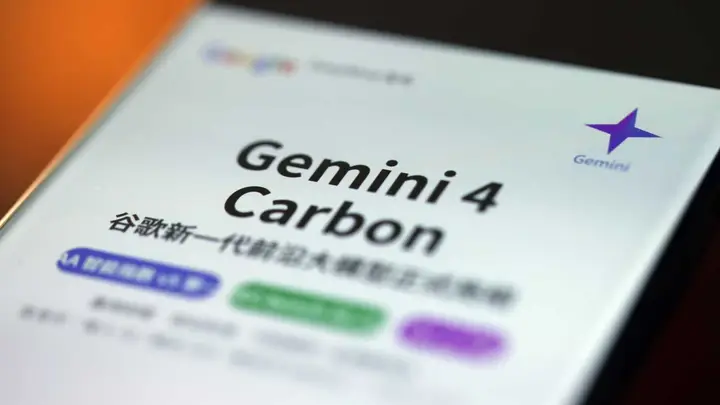
Google has released Gemini 4 Carbon, which it calls its strongest model so far. The model is built for cybersecurity work and for long, multi-step tasks such as engineering projects that run for hours or days. Google first gave access to a small group of cyber defenders, then opened it to developers, businesses, scientists and consumers on 10 November 2026.
The first announcement came from Google DeepMind. Google reported strong results on several security benchmarks, all run without guardrails. On SEC-bench Pro, which tests how well a model finds real flaws in software, Carbon scored 88.2%. On ExploitGym, which checks whether a vulnerability can be exploited, it scored 54.8%. On CWE-bench, which measures patching at the root cause, it reached 71.0%. Google also said that on its internal tests Carbon generates secure code with more than twice the success rate of its previous model, Gemini 4 Argon.
Independent figures came from the Artificial Analysis Intelligence Index, version 5. Tom's Hardware reported that Carbon scored 59 and ranked first, one point ahead of Claude Opus 5.5. The same report said Carbon led the AA-Omniscience test, which measures knowledge and hallucinations, with a score of 54 on a scale from -100 to +100. The report noted that even the best models scored well below a level that would mean reliable recall. On the WebDev Arena leaderboard, Carbon ranked fourth, with a score of 1768.
Google also described changes in behaviour. It said Carbon cuts unsupported claims by about half compared with Argon. Instead of guessing or hedging when evidence is missing, the model is said to list what is still required or raise discrepancies before it acts. Google reported that Carbon resisted every attack in the Gray Swan Indirect Prompt Injection benchmark, where Argon had a 0.7% attack success rate. These results come from Google's own testing and have not been verified by an outside party in the sources we reviewed.
The rollout was staged. Google said it was working with the U.S. government on voluntary pre-release testing. Access began with a subset of cyber defenders and then moved to trusted partners through the Fairwind Program. Tom's Hardware described wider availability as coming later. By 10 November, the reports we reviewed said Carbon was available in the Gemini app for AI Ultra subscribers and to developers and businesses. Argon remains available in the app, according to 9to5Google.
Pricing is the same as for Argon at launch. Digital Trends reported that the introductory price is $2 per million input tokens and $10 per million output tokens. Cached input tokens are priced at 95% below the normal input price. Tom's Hardware compared the cost per task on the Intelligence Index with other models. It said Carbon costs less per task than Claude Opus 5.5 and Sonnet 5.5, both with fallback, but is more expensive than some of OpenAI's models and several Chinese open-weight models. The cost comparison is based on the Artificial Analysis test and may not match real use.
The Verge reported that the general release includes an agent swarm feature, which lets several agents work on a task together. The sources we reviewed did not give full details on how that feature works or how it is priced, so readers should check Google's product pages for specifics.
Several points remain unclear. Google has not published independent audits of its safety claims in the sources. The benchmark results come from Google and from one independent index. Real-world performance may differ, especially for security work where mistakes carry risk. It is also not clear how long the introductory price will last, or whether it will change after launch.
For readers, the release matters most if they use Google's AI tools to write code, check software or run automated tasks. Users of Gemini in their daily work can now try Carbon if they have access to the right plan. People who run home systems or smart devices with their own code should treat AI-generated security fixes as drafts. Review each change before deploying it, and keep backups of any configuration you touch.
Enjoying this? Get the AI brief
Every Thursday: AI that matters for your home.
✓ Free · seven editions · one click to leave
How each source covered it
- Google DeepMindGoogle's own announcement, focused on the cybersecurity benchmarks and the staged rollout to cyber defenders28 Oct 2026
- Tom's HardwareTom's Hardware compared the model with rivals on the Artificial Analysis index and stressed cost per task and hallucination scores3 Nov 2026
- Google – The KeywordGoogle's product blog, focused on the general release to developers, enterprises, scientists and consumers21 h ago
- The VergeThe Verge highlighted the general release and the agent swarm feature21 h ago
- EngadgetEngadget focused on worldwide availability after the limited cybersecurity release21 h ago
- 9to5Google9to5Google covered the rollout in the Gemini app for AI Ultra subscribers and that Argon stays available21 h ago
- Digital TrendsDigital Trends stressed availability for developers, businesses and Ultra subscribers at the same price as Argon19 h ago
- CNET15 h ago
- Android Authority7 h ago
Original reporting by the sources above. Summary by smart-home.space.