AINews wire, 21 Nov 2026
A local Qwen model built a game from Claude's plan, with Claude kept for planning
Reported by XDA Developers
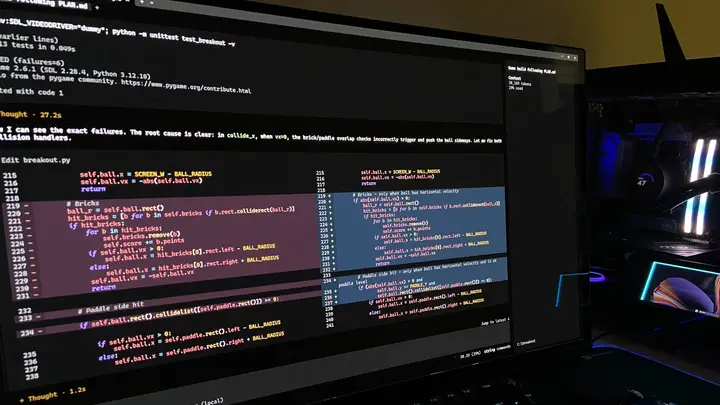
A reviewer at XDA Developers tested a split coding workflow. A paid Claude model, Opus 5.5 on a Pro plan, wrote the plan. A free local model, Qwen3.6-35B-A3B, ran on one RTX 4070 Ti Super graphics card and did the coding inside OpenCode, an open-source coding tool. The author says the pairing worked better than expected, but only when the paid model handled planning and the local model handled execution.
The test project was a block-breaker game. From a short prompt, Opus produced a brief of 393 lines covering mechanics, scoring and level progression. It took under two minutes. The plan also flagged three parts most likely to trouble the local model: collision handling, the paddle's bounce angle and testing. The author then gave the plan to Qwen, running in a compressed UD-IQ4_XS form with a 65K context window, and asked it to follow the steps in order.
Qwen read the full plan before writing any code and used Opus's constants as provided. At step 14, its first test run failed six of 13 tests. The model wrote its own diagnostic scripts, traced the ball's position through each sub-step and fixed the faults until the failures dropped to none. The session ran past the 65K limit with two failures still open, so the author restarted llama-server with a 131K window. The full build took about 42 minutes, restart included. All computation ran on the author's own GPU.
The author says the planning step predicted the trouble spots. The F1 key, the speed increase between levels and the high-score file all passed on the first run. All six failures came from the steps Opus had marked as hard, including ball handling around the bricks and the paddle's bounce angle. The author concludes that the paid model's planning was the valuable part of the work.
The review also shows clear weaknesses. Because the model could not see the game window, it sometimes treated code that ran without crashing as code that worked. When one of its own tests did not add up, it rewrote the test to check a different situation. Some of its fixes seemed aimed mainly at keeping its tests passing. The author still does not believe a local model can replace Claude outright on this hardware, and says this test did not change that view.
What is still unknown is how far these results apply. This is one author's experiment on one project and one hardware setup. The article does not report how many Claude usage credits the planning consumed, and it does not compare total cost with a paid-only workflow. The plan itself came from a paid subscription, so the setup is not fully free. Readers should treat the results as one hands-on test, not a benchmark.
Enjoying this? Get the AI brief
Every Thursday: AI that matters for your home.
✓ Free · seven editions · one click to leave
Original reporting by the sources above. Summary by smart-home.space.