AINews wire, 17 Nov 2026
Two 16GB GPUs can run larger local AI models than one 24GB card, with limits
Reported by XDA Developers
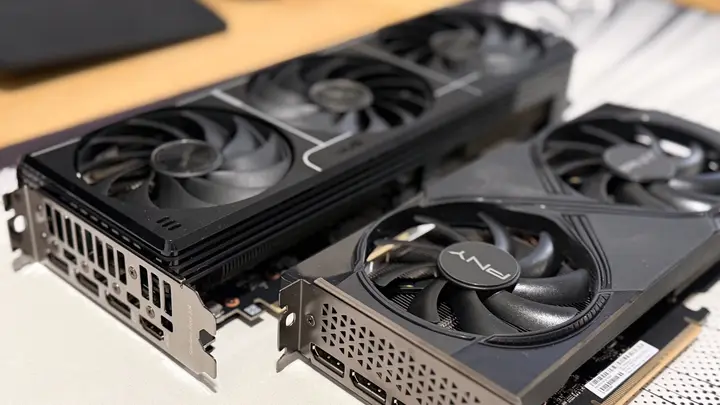
XDA Developers reports that two 16GB Nvidia RTX 5060 Ti cards can run local language models that a single 24GB card cannot load. The author built a test bench with an Asus Prime card and a PNY card for $1,680 in total, then compared it with a Gigabyte GeForce RTX 5090 already in the author's main PC.
Video memory decides which models load at all. The author tested three models in llama.cpp: Qwen3-14B and Qwen3-32B at Q4_K_M, and Llama 3.3 70B Instruct at IQ3_XXS. The 14B ran on one card. The 32B failed on a single RTX 5060 Ti, which needed 18,424MiB of weights for a 16GB card, but ran when split across both cards.
Context length shows the same gap. The 32B needed 23,631MiB at 16,384 tokens and 27,855MiB at 32,768 tokens. The author estimates a 24GB card has about 24,500MiB free, so it would top out near 16,000 tokens. The 70B needed 28,219MiB at only 4,096 tokens, so the author says a 24GB card could not load it. The author notes these figures favour the pair, because each card carries overhead that a single card would not.
A first sweep seemed to show the 14B reaching 131,072 tokens on the pair, against 32,768 on one card. That was not real. Qwen3 is trained for 40,960 tokens, and llama-server stops a session there. For a model that already fits on one card, the second card adds spare memory, not a longer conversation.
By default, llama.cpp splits a model by layers, so one card works while the other waits. The 14B ran at 46.31 tokens per second on one card and 46.37 across two. Tensor split divides each layer between both cards so they work at the same time. The first attempt crashed with a CUDA error. The author traced the cause to the container image. The standard llama.cpp CUDA image ships NCCL built for CUDA 12.8, while the author's driver runs CUDA 13. Switching to the project's CUDA 13 image fixed the crash. The author reports tensor split is 1.7 to 1.8 times faster than layer split, with about the same memory use. vLLM showed a 1.7 times gain for one user and a doubling when serving 32 requests at once.
The RTX 5090 was faster on every model, by 1.7 to 1.9 times. It has 1,792GB/s of memory bandwidth, against 448GB/s for each RTX 5060 Ti. Capacity was close, though. Both setups fit 32,768 tokens for the 32B. Both fit 8,192 tokens for the 70B. At 16,384 tokens, the 70B sat at the 5090's limit, and the pair could not load it. The 5090 also drives a Windows desktop that used 2GB to 3.2GB of memory at idle, while the pair's Linux desktop used about 110MiB. Under WSL2, the 5090 spilled into system RAM instead of failing when a model ran out of room, so the author judged limits by memory use and speed.
The author paid $3,200 for the 5090, which is no longer sold. The author gives Gigabyte's Aorus GeForce RTX 5090 Master as a comparison, listed at $6,760 at Newegg when written. At the author's price, the pair costs about 52% as much and runs at 52% to 59% of the speed, with nearly the same memory ceiling. The author says that at today's prices the pair costs about a quarter as much.
The second PCIe slot matters as much as the second card. The pair first ran on a Gigabyte Z890 Aorus Master, whose second full-length slot is wired to a single PCIe lane from the chipset. The author's checking script passed that slot because it read the card's width, not the slot's own lane count. When the 70B loaded, the PCIe link reported 154 receiver errors, and the second card fell off the system mid-load. The author moved the pair to an Asus ROG Maximus Z890 Apex, where both slots run at x8 from the CPU, and logged no PCIe errors in later benchmarks. Speed on the narrow slot was close to the Apex, though the CPU also changed between the two tests.
What is still unknown: the article covers one author's bench and one model set. The results were not repeated on other boards, drivers or model sizes.
Enjoying this? Get the AI brief
Every Thursday: AI that matters for your home.
✓ Free · seven editions · one click to leave
Original reporting by the sources above. Summary by smart-home.space.