EnergyNews wire, Yesterday
Adding wind to solar and batteries cuts cost of 90% firm power, Ember says
Reported by pv magazine, Electrek
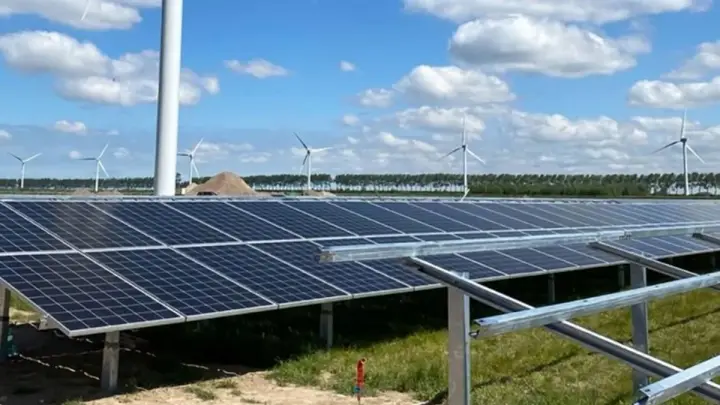
The UK-based think tank Ember says that adding wind power to systems that pair solar panels with battery storage lowers the median cost of meeting 90% of electricity demand by nearly one-fifth. The median falls from $105 to $86 per megawatt-hour, or from $0.105/kWh to $0.086/kWh. Coverage of the study by pv magazine and Electrek reports the same figures. The model uses ten years of weather data, region by region and hour by hour.
The main effect is on storage. Wind covers many periods when solar output is weak, so less battery capacity is needed to reach 90% coverage. According to the analysis, in Canada the requirement falls from 24 hours of demand to 10. In the United States and Europe it drops from 20 hours to 12, and in China from 18 hours to 12. India, where wind has a smaller effect, stays at 14 hours.
The cost gains also spread to more countries. With wind included, regions that account for 75% of global electricity demand can cover 90% of their demand for less than $0.10/kWh. Without wind, that share is about half. Electrek puts the solar-and-battery-only share at 50%.
Solar output becomes more seasonal farther from the equator, while wind is often strongest when sunlight is weakest. In Europe, wind produces 44% of its annual output between November and February, against 12% for solar. North of 45 degrees latitude, adding wind cuts the median cost of 90% coverage by 40%, from $0.164/kWh to $0.099/kWh. South of 40 degrees south, in Chile and Argentina, the reduction is about one-third.
Ember also looked at prolonged periods of low output. Weighted by demand, a week of low solar output occurs roughly four times a year worldwide, and a week of low wind output about eight times. Low weeks for both coincide about once every four years. In Germany, the worst combined week of the decade produces a deficit of about five days of average demand, compared with six days when either technology is used alone. A low-output week is defined as seven consecutive days below half the average output.
The study also looks at backup generation. A solar-plus-storage system meeting 90% of demand has an average cost of $0.105/kWh in the model. At $0.098/kWh, a system with wind reaches 95% coverage, which halves the demand that backup generation must cover. For 90% coverage with backup, the demand-weighted average cost is $0.089/kWh with wind, compared with $0.140/kWh for solar and batteries alone.
Ember identifies 845 GW of coal and gas capacity in planning. With wind included, 90% of that capacity sits in regions where a renewable alternative would cost less than $0.100/kWh, compared with 71% without wind. Including backup, 706 GW sits in such regions, against 520 GW without wind. Electrek reports that wind alone brings another 91 GW of planned Chinese capacity into that range.
Ember estimates that firm power from solar and wind with storage could fall from $0.089/kWh today to $0.052/kWh by 2050, based on the regional cost projections in its model. These results depend on assumptions. The model assumes constant baseload demand and uses a single 7% cost of capital for comparisons. When regional capital costs are applied, the European median rises from $0.099/kWh to $0.104/kWh, and the African median rises from $0.076/kWh to $0.126/kWh.
Ember has also published an interactive atlas that lets readers check reliable electricity costs for their own region.
Enjoying this? Get the Energy brief
Every Friday: prices, subsidies and what changed in your market.
✓ Free · seven editions · one click to leave
How each source covered it
- pv magazineFocused on the cost of 90% firm power, the storage and regional figures, and the planned coal and gas capacity questionYesterday
- ElectrekFocused on the cost reduction, the Ember and GWEC link, the low-output weeks and the fossil plant outlook, with a quote from Ember principal Daan WalterYesterday
Original reporting by the sources above. Summary by smart-home.space.