EnergyNews wire, 3 h ago
Bird droppings cost solar panels about 6% a year, and common models miss it
Reported by pv magazine
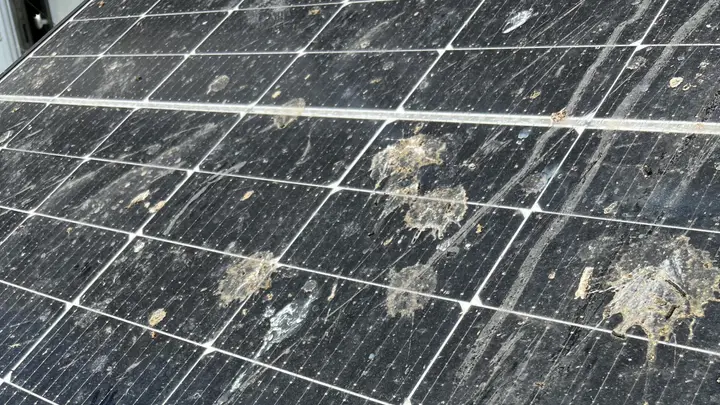
An international research team has reported a year-long field study of how bird droppings affect solar panels. According to pv magazine, which covered the study on 24 November 2026, the team found that this kind of soiling can cut annual output by around 6 percent. The researchers also found that common soiling models underestimate these losses.
The experiment used two monocrystalline modules installed at ground level at the University of Split in Croatia. One module stayed clean as a reference, while the other collected natural dirt. Both sat on an open frame with the same tilt, direction and height, so they saw similar light and temperature. Weekly checks ran from July 2024 to July 2025. At each session the team measured current-voltage curves, along with irradiance and module temperature, near solar noon under clear skies.
The researchers compared the short-circuit currents of the two modules to get a soiling ratio. Over the period the average ratio was 0.941, which means losses of roughly 6 percent, or an estimated 72.1 kWh per kWp each year. In November 2024, after a long dry stretch, the figure slipped under 0.90, with droppings as the main source of dirt. Later rain only partly recovered output, and the ratio settled between about 0.94 and 0.96.
A second build-up in April and May 2025 pushed the ratio down to about 0.90. The estimated daily losses in those two months were 0.41 kWh/kW and 0.47 kWh/kW. In the test, manual cleaning was the only method that fully restored performance.
The team also tested three established soiling models, which use particulate matter levels and rainfall. Two assumed full cleaning after more than 1 mm of daily rain, and one allowed partial cleaning. All three underestimated the losses. The authors say these models rely mainly on gradual dust-like deposition, so their estimates may be unreliable where droppings build up differently. They suggest that future models include more soiling measurements, more detailed rainfall data and saturation effects.
The team further tested a method that estimates clean-module output from irradiance and temperature data, without keeping a clean reference module. The authors say its accuracy depends on calibration and operating conditions, and that more validation across other sites is needed.
The findings appear in a paper in Solar Energy on uncertainty in modelling urban photovoltaic soiling. The study covers one site and one module type, so the figures may not transfer directly to other locations. The researchers also note that the local factors driving the build-up, such as bird activity and nearby nesting areas, still need to be identified.
Enjoying this? Get the Energy brief
Every Friday: prices, subsidies and what changed in your market.
✓ Free · seven editions · one click to leave
Original reporting by the sources above. Summary by smart-home.space.