EnergyNews wire, 1 h ago
Cellular base stations may change solar module resistance, a small study finds
Reported by pv magazine
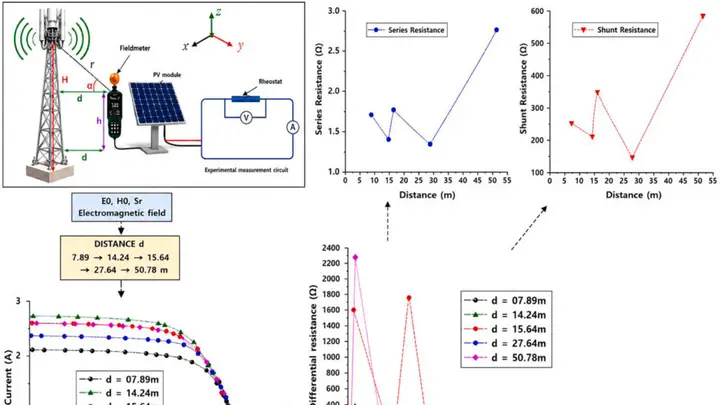
A research team in Burkina Faso has tested whether radio signals from a mobile phone base station affect how well a solar panel turns light into power. The work was reported by pv magazine and published in the journal Energy Reports. The authors found that electromagnetic fields near the station changed the internal electrical behaviour of a panel, and in some cases its output.
The team tested a 50 W monocrystalline silicon module on the campus of Joseph Ki-Zerbo University in Ouagadougou. They placed it at five points between about 7.9 metres and 50.8 metres from a station that supports several radio technologies. The measurements were taken around midday on 18 November 2025, under clear skies and at roughly 27.5 °C. At each point, the scientists recorded the field strength with a triaxial meter and measured the panel's current-voltage curve.
The strongest field, 15.76 V/m, was measured at 27.64 metres, where the radio-frequency power density reached 659 mW/m². At that point the module's series resistance and shunt resistance were at their lowest values, 1.33 ohms and 146.9 ohms. They rose to 2.78 ohms and 593.4 ohms at 50.78 metres. The panel produced its highest output, 30.1 W, at 14.24 metres. At the point of maximum exposure it produced 28.0 W.
The researchers also saw large swings in resistance at low voltages at 7.89 metres and 15.64 metres. The authors describe the effects as nonlinear and dependent on both field strength and the antenna's radiation pattern. They warn that changing sunlight, wind, temperature and several coexisting base station technologies could affect the measurements. The study also refers to a 2021 modelling work that suggested similar exposure could raise electrical losses and contribute to cell degradation in polycrystalline cells.
Still unknown: whether these effects matter over years of operation, and how much energy yield would change in a real installation. The authors say future work should use more controlled conditions to isolate the effect and measure its long-term impact on reliability. The study covers one panel at one site, so it does not measure typical home systems.
Enjoying this? Get the Energy brief
Every Friday: prices, subsidies and what changed in your market.
✓ Free · seven editions · one click to leave
Original reporting by the sources above. Summary by smart-home.space.