EnergyNews wire, 20 Nov 2026
China connects first artificial-cavern compressed air storage plant to grid
Reported by pv magazine
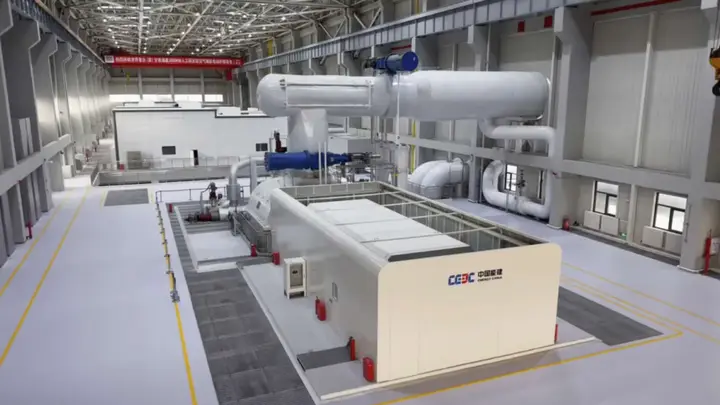
China has connected Yuanchu No. 1, a compressed air energy storage (CAES) station in Yumen, Gansu province, to the grid for the first time on November 16. The developer, China Energy Digital Technology Group, says it is the first grid-connected CAES facility to use underground rock caverns that were excavated for the purpose, according to pv magazine.
The plant is rated at 300 MW and 1,800 MWh. It is designed for an eight-hour charging cycle and six hours of continuous discharge. Total investment is about CNY 2.5 billion, or $368 million. The developer expects annual generation of 600 GWh.
The storage system uses four connected chambers cut about 110 meters below the surface in hard rock. Together they give roughly 200,000 cubic meters of pressurised space, with a design pressure of 18 MPa. The plant uses non-combustion, adiabatic technology. Heat from compressing air is captured and stored, then reused during discharge, so no natural gas is burned.
The thermal system combines low-melting-point molten salt with pressurised hot water, according to molten-salt supplier Shandong Huayang Dier Chemical. Lower-temperature heat goes to water tanks and higher-temperature heat goes to molten-salt tanks. The developer also reports shared heat-exchange equipment, which reduces duplicated parts.
The developer reports a round-trip electrical efficiency of 72%. Independent operating data have not yet confirmed that figure.
The design matters because salt caverns, the usual choice for underground air storage, need suitable geology. Hard-rock caverns could widen the number of possible sites. Geological conditions and construction costs still count.
The station sits in the Hexi Corridor, a large wind and solar zone in northwest China. It will store surplus renewable power during off-peak hours and feed it back when demand rises, giving several hours of balancing capacity.
China already has several large CAES projects connected, including a 600 MW salt-cavern station in Huai'an and a 700 MW project in Jintan. An October 2026 report from the China Industrial Association of Power Sources counts 13 projects under construction, totalling 4.95 GW and 23.95 GWh. Industry figures cited in November point to more than 36 GW in preparation. Many of these projects still depend on financing, geological checks and commercial viability.
For Yuanchu No. 1, long-term efficiency, cavern integrity and running costs will show whether the artificial-cavern approach can be copied at a sensible cost.
Enjoying this? Get the Energy brief
Every Friday: prices, subsidies and what changed in your market.
✓ Free · seven editions · one click to leave
Original reporting by the sources above. Summary by smart-home.space.