EnergyNews wire, 11 Nov 2026
Gaggenau utility plans 30 MWh zinc-bromine battery, commissioning set for 2028
Reported by pv magazine, Energy-Storage.news
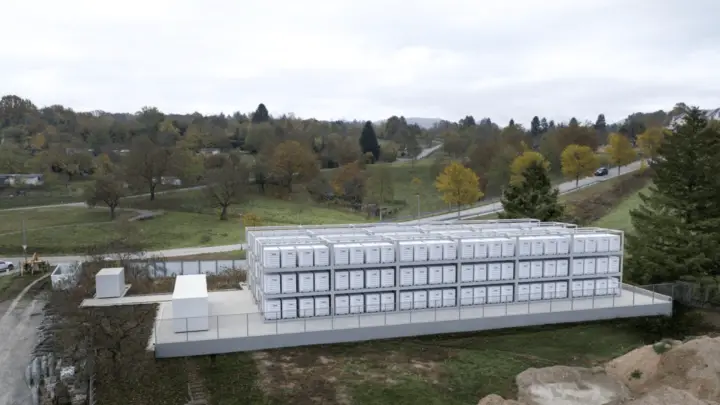
Stadtwerke Gaggenau, the municipal utility of the German town of Gaggenau, plans a large battery storage system with Capac AG, a German energy infrastructure company. The 7.5 MW, 30 MWh system uses zinc-bromide technology from the US maker Eos. Construction is due to start in 2027, and commissioning is planned for 2028. According to pv magazine, the project costs €15.2 million ($16.8 million). Energy-Storage.news reports that the utility has hired a general contractor for the four-hour project.
Capac is the general contractor. Its role covers technical planning, procurement, system integration and construction up to commissioning. The system will stand on the former site of the utility's liquefied gas plant. Stadtwerke Gaggenau and JP Holding, the parent company of Capac, are investing jointly. The planned revenue comes from arbitrage trading in the day-ahead and intraday power markets, plus additional ancillary services.
Capac's chief executive, Benjamin Henecka, says the main strengths of zinc-bromine are its water-based electrolyte, which does not burn, its long service life and its low expected loss of capacity. He says the design aims at a quarter-century of operation, with capacity loss of about 3.6 percent over that time, and that the chemistry avoids thermal runaway. He argues that buyers should compare the full cost over the investment period, not only the purchase price. He also says the company does not claim that zinc-bromine wins on every measure.
Eos supplies the battery units. They are modular and fitted into a steel frame that allows horizontal or vertical arrangement. The batteries are made in Pennsylvania. Henecka says the non-flammable chemistry allows a compact layout and a different fire-risk profile from lithium-ion systems. He also presents the partnership as a way for European utilities to widen their supplier choice and reduce their dependence on lithium-ion supply chains, which are dominated by China. He stresses that this does not mean full supply-chain independence.
In June, Capac and Eos announced a separate 5 MW, 22 MWh project in Bruchsal. They also agreed a deal covering 2 GWh of storage across Germany, Austria and Switzerland through 2031.
The reports describe the Gaggenau project as planned, not yet built. They do not give a final contract value beyond the figures above or confirm the start date of construction.
Enjoying this? Get the Energy brief
Every Friday: prices, subsidies and what changed in your market.
✓ Free · seven editions · one click to leave
How each source covered it
Original reporting by the sources above. Summary by smart-home.space.