EnergyNews wire, 11 Nov 2026
IEA says most Chinese solar makers still lose money as module prices recover
Reported by pv magazine, pv magazine USA, Electrek
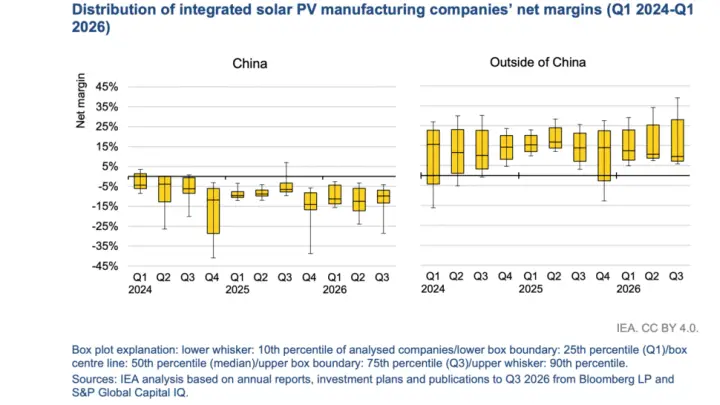
The International Energy Agency (IEA) says more than 90 percent of major Chinese solar PV makers are still reporting net losses. The finding appears in a chapter on renewable manufacturing supply chains in its Renewables 2026 report. Higher module prices, now 10 to 30 percent above 2025 levels, have not been enough to bring the sector back to profit.
According to the report, the combined net loss of major Chinese solar manufacturers and polysilicon producers grew from roughly 4.4 billion dollars in 2024 to nearly 5.5 billion dollars last year. More than 70 companies have filed for bankruptcy or liquidation since 2024. Net margins stayed negative through the first three quarters of 2026, but the IEA sees signs that losses are levelling off. The middle half of analysed firms now reports margins between minus 5 and minus 15 percent, a narrower band than the zero to minus 30 percent range seen in 2024. The improvement is concentrated in companies that have moved into higher-margin areas, such as energy storage system integration.
The IEA expects China to keep a tight grip on solar supply chains through 2031, especially for polysilicon and wafers. Consolidation should favour firms with strong balance sheets, better capacity and stronger technology, while weaker producers exit or are absorbed. Upstream segments will adjust most, because they hold most of China's excess capacity.
Outside China, some manufacturers remain profitable. The report says their median net margins have stayed at 10 to 15 percent since 2023, helped by technology, local production and access to protected markets. India is emerging as a manufacturing hub, mainly for cells and modules, which need less upfront investment than polysilicon and wafers. The IEA also notes that trade barriers and industrial policy increasingly shape where new capacity goes.
The outlook depends on market conditions. If bankruptcies continue and no major new investment arrives, global polysilicon capacity could fall by up to 45 percent by 2031. If markets recover, the cut could be about 15 percent. Wafer capacity may fall 10 to 35 percent, and cell and module capacity 5 to 15 percent. Many makers are shifting into battery storage, which the IEA says may offer stronger margins. It warns that this could carry solar-style overcapacity into batteries if supply again outruns demand.
The figures are the IEA's own estimates and scenarios, not outcomes.
Enjoying this? Get the Energy brief
Every Friday: prices, subsidies and what changed in your market.
✓ Free · seven editions · one click to leave
How each source covered it
Original reporting by the sources above. Summary by smart-home.space.