EnergyNews wire, 21 h ago
MicroQuanta reports 23.9% efficiency for a 19.48 cm² perovskite solar module
Reported by pv magazine
A research team led by scientists at MicroQuanta Semiconductor, a Chinese maker of perovskite solar cells, reports a new record efficiency for a perovskite module. The mini-module measures 19.48 square centimetres and reached a certified steady-state efficiency of 23.9 percent. The result was certified by the National PV Industry Measurement and Testing Center, part of China's Fujian Metrology Institute, according to pv magazine.
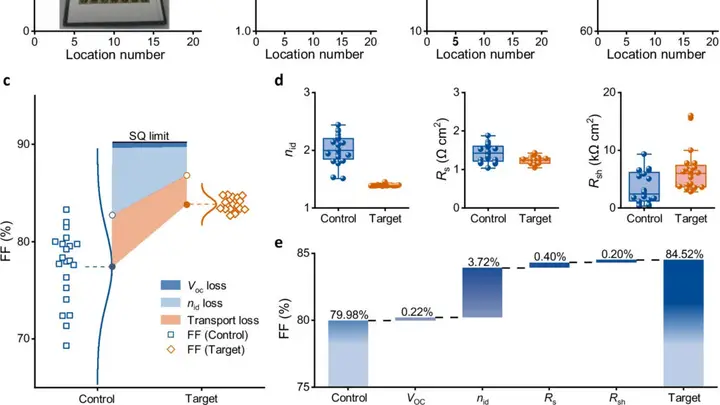
The team wanted to find out why efficiency drops when small lab cells are scaled up into larger modules. Using a Shapley value analysis, they split the loss between open-circuit voltage, short-circuit current density and fill factor. After first accounting for current losses in the inactive strips created by laser scribing, they found that fill factor was the largest cause of the drop.
To reduce this loss, the researchers cooled the wet perovskite film for 15 seconds, to between 0 and 10 degrees Celsius, right after coating. They moved it into a vacuum chamber within about five seconds, vacuum-flashed it and then annealed it. The team says the cooling slows the change from an intermediate phase into perovskite, which produces larger and more even grains.
The module has eight subcells connected in series by laser scribing. It was made by slot-die coating on glass, with a formamidinium-cesium lead iodide absorber. The reported fill factor is 83.3 percent, which the authors describe as the highest for a perovskite module. The geometric fill factor is 97 percent, meaning 97 percent of the aperture area is photoactive.
In separate aging tests under continuous one-sun light at open circuit, the efficiency loss linked to a falling fill factor was less than one-third as large in cooled modules as in control modules. The authors suggest that protecting the fill factor could be a shared goal for efficient, stable and scalable perovskite solar panels.
This is a laboratory and pilot-scale result. The same company reported a certified 21.86 percent efficiency for an 810 square centimetre module in January 2025. It also plans a gigawatt-scale production line in Quzhou, Zhejiang province, and showed a perovskite-silicon tandem module for building-integrated photovoltaics at The smarter E Europe 2026 in Munich. That tandem module has a reported efficiency of 26 percent and power outputs from 65 W to 165 W.
The sources do not give prices, sale dates or field lifetimes for the record module. The study, published in Nature Communications, lists authors from MicroQuanta, Zhejiang University, China Three Gorges Renewable, Zhejiang Provincial Key Laboratory of Optoelectronic Functional Materials and Devices, and the Australian Centre for Advanced Photovoltaics. Further details on commercial timing have not been published in the reports we reviewed.
Enjoying this? Get the Energy brief
Every Friday: prices, subsidies and what changed in your market.
✓ Free · seven editions · one click to leave
Original reporting by the sources above. Summary by smart-home.space.