EnergyNews wire, Yesterday
Perovskite tandem solar moves from labs toward field tests and factories
Reported by pv magazine
Perovskite tandem solar cells are moving from laboratory records toward commercial production, according to a panel session at Solar Manufacturing USA 2026, hosted by pv magazine USA. Speakers said the industry now focuses on long-term field durability, bankability and factories that can make gigawatts of product. The report was published by pv magazine on 26 November 2026. The core idea is simple. Conventional silicon cells are close to their physical limits, so developers want to add a light-absorbing perovskite layer to capture more energy from the same area.
Ralf Preu, director of photovoltaics at Fraunhofer ISE, gave the historical view. He put the efficiency limit for a single-junction silicon cell at 29.4 percent. He noted that Longi has announced a cell at 28.1 percent, and that silicon modules are at 26.4 percent. He said a perovskite-silicon two-junction cell could reach a theoretical 43.2 percent, about 14 points higher. Triple junctions could eventually go beyond 50 percent.
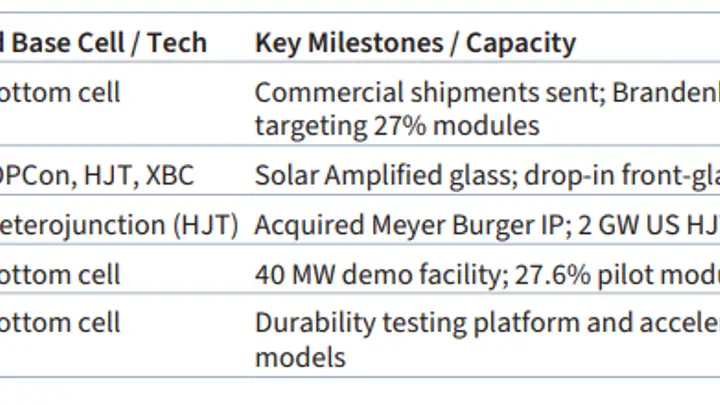
Oxford PV described its move from research into manufacturing at a pilot line in Brandenburg an der Havel, Germany. Its product line includes the Centauri and Pegaso series, aimed at mainstream utility projects and lightweight specialty uses. Dr Laura Miranda, chief strategy officer, said the company targets 25 percent module efficiency in 2026, with a ten-year guarantee, and a twenty-year guarantee by 2027. She said 2027 is the point when scaling up makes sense on cost. Oxford PV also plans to license its technology to module makers rather than block rivals.
Other developers avoid rebuilding a panel maker's silicon lines. Caelux presented Solar Amplified glass, which replaces the standard front glass of a module with power-producing glass. Aaron Thurlow, chief commercial officer of Caelux, said the swap raises output across PERC, TOPCon, HJT and back-contact designs while leaving the cell lines unchanged.
Tandem PV takes a different route. It stacks a perovskite layer over a silicon cell and wires them together inside the junction box. The company runs a 40 MW demonstration facility in Fremont, California, using standard equipment and 1,200 mm glass. Dr Colin Bailie, chief technology officer, said the company chose this width to reduce scaling risk. The stacked modules mount on standard racking, and Tandem PV reported a 27.6 percent pilot module efficiency on 0.7 square metres, with under 1 percent annual degradation. These figures are company results, and the report does not show independent testing.
Tandem PV plans to ship field test kits in late 2026, with full bankability reports in 2027. It targets a gigawatt-scale plant in the United States in 2028. These dates are company plans, not confirmed commitments.
Swift Solar argued that silicon HJT is the best base for perovskite top cells. Dr Joel Jean, chief executive and co-founder, said Swift acquired intellectual property worth over 200 million dollars from Meyer Burger, along with more than 2 GW of cell manufacturing equipment and the company's leadership. Swift plans a 2 GW factory in the United States to produce HJT modules. Jean said it was the first time this plan was discussed in public. The source text ends before it describes the phasing of that plan.
The report leaves several points open. It gives no retail prices, no availability dates for home buyers, and no independent verification of the efficiency or degradation figures. Most claims come from companies and conference remarks, so readers should treat them as statements, not confirmed results.
Enjoying this? Get the Energy brief
Every Friday: prices, subsidies and what changed in your market.
✓ Free · seven editions · one click to leave
Original reporting by the sources above. Summary by smart-home.space.