EV & MobilityNews wire, 23 h ago
Polestar's Formula 2030 concept previews next Polestar 2 and brings physical buttons back
Reported by InsideEVs, Electrek, Ars Technica and 4 more
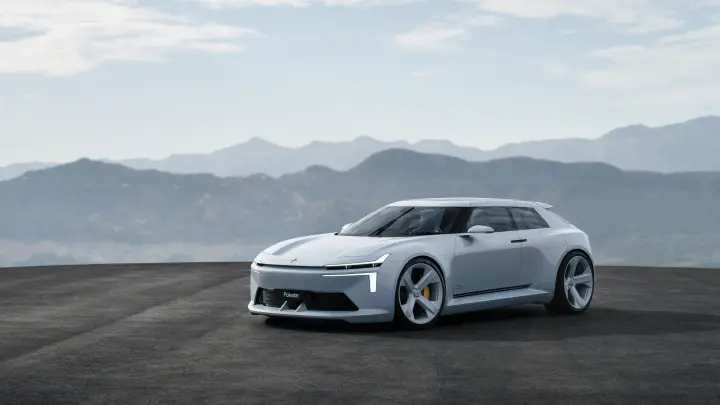
Polestar has unveiled the Formula 2030, a concept for a low four-door electric sports car. The company says it previews the design of the next Polestar 2, due in 2027, and the Polestar 7 compact SUV. Sources describe it as a design study, and Polestar has not said it will build it. The concept was first shown privately to investors and retailers in Gothenburg in September. It is the first show car from head of design Philipp Römers, who joined from Audi in 2024.
The concept is 4,680 mm long and 2,021 mm wide, on a 2,780 mm wheelbase. It stands 1,350 mm tall, which is lower than the Polestar 5 grand tourer. Electrek says it is about three inches longer than the current Polestar 2 and roughly five inches lower. Ars Technica describes it as about the same length as that car. The sources differ on this point, so the exact comparison is not settled. The concept uses 22-inch wheels, gold brake calipers and visible dampers in the trunk.
On the outside, the Dual Blade headlights carry over. They sit in an aero wing above a shark-style nose, which Polestar says is the face of the next Polestar 2. The full-width light bar, common on many EVs, is replaced by Single Blade rear lights. Polestar says these are introduced ahead of series production. A LiDAR unit sits under a shroud and shows only when the car drives itself. The windscreen has a single vertical wiper.
Inside, the four seats have inflatable bolsters that adjust to each occupant. Their backs use a flax-based composite instead of virgin plastic. Google Gemini is built in, as in Polestar's production cars. A curved 20-inch display, which Polestar calls HyperDIM, sits on the steering column. A 12.2-inch centre screen sits in the tunnel. The main change is a set of eight physical controls for the most-used functions. Owners could switch control types, such as rocker switches or rotary knobs, and set what each one does. Ars Technica says the physical controls are meant for manual driving, while autonomous driving remains a focus. Three drive modes, Performance, Normal and Autonomous, change the cabin layout.
The rear is the most unusual part. The back opens like a clamshell, and the trunk floor is transparent, with custom bags strapped underneath. The front trunk holds two race helmets and a fire extinguisher. Electrek calls the rear design unusual and says it is a lot to take in.
According to Ars Technica, the concept also explores sustainability. The design uses monomaterials where possible and is built with recycling in mind. The interior door panels are fully recyclable. The chassis uses low-emission steel, and biocomposites replace conventional plastics in several places. The sources do not say how much of this would reach production.
The unknowns are large. Polestar gave no battery size, range, power output or price. It also did not confirm that the hatchback form will go into production. Car and Driver says the concept previews designs that will reach production cars within about two years. Electrek reports that Polestar plans four new models in three years, and that the Polestar 7 will be built in Europe.
The brand's position is also part of the story. Ars Technica and Electrek both report that Polestar cannot sell cars in the US under the federal connected-vehicle rule. Ars Technica links this to the brand's Chinese parent company, Geely. Electrek also reports a first-half loss of 842 million dollars and a negative gross margin for the company. Both sources frame the concept as a design statement, not a sign of near-term financial recovery.
Enjoying this? Get the EV & Mobility brief
Every Wednesday: charging, cars and costs.
✓ Free · seven editions · one click to leave
How each source covered it
- InsideEVsFocused on the return of physical controls and the interior's customisable features, with a note on the Polestar 2 and 7 link.10 Nov 2026
- ElectrekStressed the concept's size and height compared with the Polestar 5 and the upcoming Polestar 2 and 7.10 Nov 2026
- Ars TechnicaLooked at the design lineage, the Geely link and US sales limits, plus the sustainability materials.10 Nov 2026
- Car and DriverFramed the concept as a look at tactile driving and a preview of designs for production cars within two years.Yesterday
- EngadgetHighlighted the inflatable seats, the pop-up LiDAR and the physical buttons, alongside the US ban.Yesterday
- T3Presented the concept as a hint at the next Polestar 2 and 7, with the focus on the buttons.Yesterday
- Electrifying.comShort preview centred on the new design direction, with little detail beyond the excerpt.23 h ago
Original reporting by the sources above. Summary by smart-home.space.