EV & MobilityNews wire, 24 Nov 2026
Porsche's electric 718 Boxster is due in early 2027, with virtual gears and a boxer sound
Reported by The Drive, T3, Ars Technica and 3 more
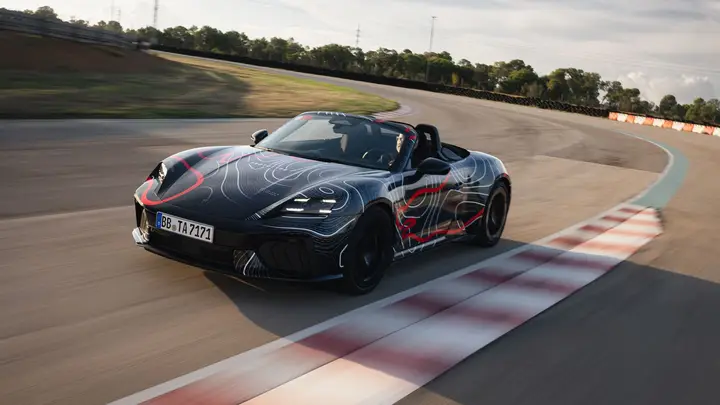
Porsche is preparing an all-electric version of its 718 Boxster roadster. The company now gives the first quarter of 2027 as the arrival window. The model was first expected in 2022, then in 2025, so the delay has been long. Early drivers have now tested prototypes on canyon roads near Los Angeles and on a race track.
Full specifications have not been released. What is known so far is that the car will be a two-seat roadster with rear-wheel drive and an 800-volt electrical system. Every version uses a single motor at the rear, and only the rear wheels receive power. A limited-slip differential is available. Porsche says the most powerful model accelerates from a standstill to 60 mph in under three seconds and has a top speed of 155 mph. Power output, range and charging speed have not been published.
The battery pack sits behind the seats instead of beneath them. Porsche calls this layout E-Core. The company says it lets the seating position sit lower while keeping the 40:60 front-to-rear weight split typical of a mid-engined sports car. Reviewers noticed how low the car sits. One reviewer said the seat height was almost unheard of for an electric car.
Weight figures do not agree. T3 reports that Porsche describes the car as similar in weight to the current 911 GTS convertible, which it puts at around 1,675 kg. That would make it roughly 300 kilograms heavier than the current 718 Boxster GTS with the 4.0-litre engine. The Drive received a comment that the car weighs about the same as a 911. Its reviewer estimated a curb weight of roughly 3,300 to 3,500 pounds. Porsche has not confirmed a final figure.
The headline feature is E-Shift, a virtual transmission. A button on the steering wheel switches it on. It imitates Porsche's seven-speed dual-clutch gearbox, known as PDK. The system works in automatic or manual mode, and the paddles can be used in both. Porsche says performance is the same whether E-Shift is on or off, because torque is raised briefly during each shift. The Drive's reviewer found the shifts smoother than those of the Hyundai Ioniq 5 N and Ioniq 6 N, which he said shift more harshly.
The sound is also virtual. With E-Shift active, the cabin and a rear-mounted speaker play a recreated six-cylinder boxer sound, based on the 981-generation Boxster GTS. Sport mode adds a faint artificial engine note, and Sport Plus adds more. The reviewer said the sound felt convincing, although the seats do not vibrate. He also said the noise did not give him a headache during long canyon and track runs, unlike the Hyundai. The engineers said the driver can choose between a quiet cruise and the full sound.
Several parts come from the 911. The steering is based on the 911 Carrera GTS, and the brakes and wheel dimensions match the 911. Carbon ceramic brakes will be an option, but the prototypes did not have them. Rear-wheel steering is available, which would be a first for a Boxster. A firmer sport suspension lowers the car by 0.78 inches. All models use adaptive dampers. When E-Shift is off, the paddles can switch between three levels of regenerative braking.
Reviews agree on the driving experience. The Drive called the steering precise and easy to place, and said the car is easy to slide and control. Ars Technica wrote that the car is fun to drive, but added that technical details are still limited. Electrek reported that the car is in the final stage of development and described it as the most powerful 718 so far. InsideEVs collected early opinions from several critics. The sources agree that prototypes were tested, but production cars may change.
Several questions are still open. Porsche has not yet confirmed the battery size, the range, the charging speed or the price. It is also unclear whether the carbon brakes or other options will become standard. Porsche has said it will share more information closer to the on-sale date. Porsche also says the prototypes covered around 2.5 million test miles across cold and hot climates, from the Arctic to Death Valley.
For most smart-home and EV readers, this is a sports car, not a family vehicle. Its home charging needs cannot be judged until Porsche publishes charging figures. The engineering choices are still worth noting. A virtual gearbox and a recreated engine sound show how carmakers now copy the feel of combustion cars in electric models.
Enjoying this? Get the EV & Mobility brief
Every Wednesday: charging, cars and costs.
✓ Free · seven editions · one click to leave
How each source covered it
- The DriveA hands-on prototype review focused on the driving feel, the virtual gearbox, the sound and the 911 parts.24 Nov 2026
- T3A news report on the delayed launch, the E-Core battery layout, the 911-derived parts and Porsche's own figures.24 Nov 2026
- Ars TechnicaA road-test report that focused on the low seating position and how it follows from the battery placement.24 Nov 2026
- ElectrekA short piece on the car nearing the end of development, with an early look at the design and its power.24 Nov 2026
- InsideEVsA roundup of early critical reactions to the prototype reviews.25 Nov 2026
- Electrifying.comA brief opinion-style piece on the new electric Boxster as a sports car with a long history.4 h ago
Original reporting by the sources above. Summary by smart-home.space.