GadgetsNews wire, 18 h ago
Nvidia RTX Spark mini PC: fast local AI at a high price
Reported by Tom's Guide, NVIDIA Blog
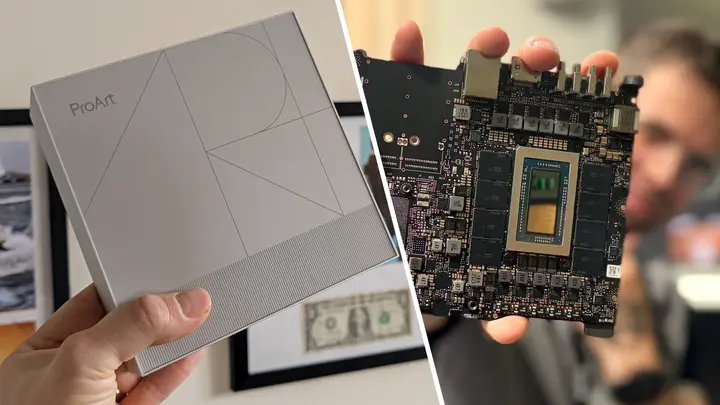
Tom's Guide has tested Nvidia's RTX Spark chip in a desktop mini PC, after a week of use. The reviewer tried the Asus ProArt GR1X, which pairs RTX Spark with 128GB of memory. The tested version costs $6,999, and Asus lists the model from $4,499. The reviewer says the chip makes more sense in a laptop. In a desk-bound mini PC, it has to compete with desktops rather than laptops.
The reviewer compared it with two other systems. The first is the Geekom A9 Mega, which uses AMD's Ryzen AI Max 395 with the same 128GB memory pool and costs $3,000 less. The second is a custom desktop with an RTX 5070 Ti graphics card, which the reviewer estimates would cost about $4,000 less on PC Part Picker.
For local AI, the reviewer used LM Studio with the Qwen 3.8 27B model. Two measures mattered: tokens per second, which shows how fast text is produced, and time to first token, which shows how long the model takes to start answering. The Asus machine responded in under a second. The reviewer says this made a self-hosted agent, reached from a Telegram app, feel quick and natural. The reviewer also sketched a home use: an agent that sorts email and links to Home Assistant to start a robot vacuum. This was a scenario, not a tested setup.
The Geekom reached about 24 tokens per second. The reviewer says that is faster than a person can read, but the reply starts after a noticeable pause. The desktop is a different case. With a 27-billion-parameter model, most of the data does not fit in the 16GB of graphics memory. The rest moves to system RAM. The reviewer reports that speed falls from more than 60 tokens per second to about 4 to 5.
The review also covers Nvidia PAIR, a feature that lets supported devices share AI compute. The reviewer started a longer task on the Spark machine from a MacBook Pro, while a short task ran on the RTX 5070 Ti desktop.
Creative work gives a different picture. The reviewer used ComfyUI for local video generation and the Procyon benchmark suite. In the same ComfyUI video test, the Spark machine was nearly three times faster than the AMD system. The reviewer says a 3D artist, indie developer or ad agency working to a tight deadline could see the price pay back. The desktop would still win in standard graphics work. However, the reviewer says it runs out of graphics memory when generating large AI video or handling big 3D scenes. The desktop also draws more than twice the power of the Spark system.
For everyday users, the reviewer is less convinced. He used the machine for little beyond a YouTube intro and some experiments. He notes that Adobe Creative Suite is now optimised for RTX Spark, but he did not use it much. He also criticised Asus for leaving out an SD card reader, which means extra dongles for moving photos.
Gaming is the weakest point. The reviewer ran 3DMark and tested games at 1440p, with and without DLSS. His conclusion is that anyone who cares most about games should buy a gaming PC. The frame-rate figures for individual games are not given in the text we used, so we do not report them here.
What is still unknown: this is one reviewer's week-long test, not an independent lab test. The text we used does not give a release date or a list of retailers. Readers should check current prices and benchmarks before buying.
Enjoying this? Get the Gadgets brief
Every Monday: the gadgets worth your money.
✓ Free · seven editions · one click to leave
How each source covered it
Original reporting by the sources above. Summary by smart-home.space.