EnergyNews wire, Yesterday
Enverus sees 1,080 GW of new US generation by 2050, led by batteries and solar
Reported by pv magazine USA
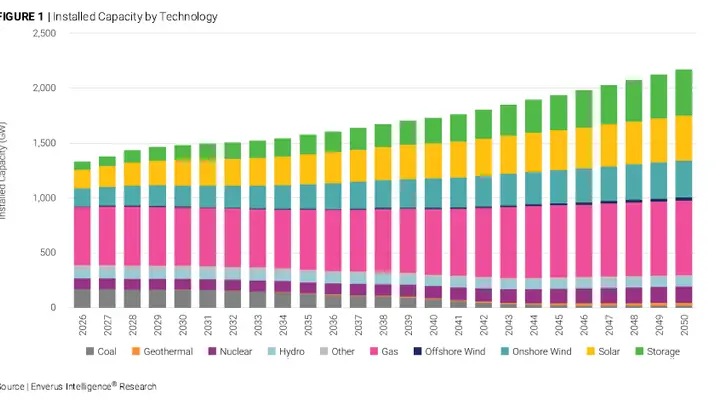
A new study from Enverus, a Canada-based energy research firm, expects the continental United States to add about 1,080 GW of power generation before 2050. Installed capacity would climb from 1,435 GW in 2026 to 2,284 GW by that date. Pv magazine USA reported the findings on 24 November 2026.
Battery storage is the largest single source of new capacity in the forecast, at 376 GW. Solar follows with 241 GW. Gas adds 184 GW, while onshore wind reaches 175 GW. Enverus expects fast-to-build renewables to win most new projects, while dispatchable plants stay in the mix for reliability.
Juan Arteaga, principal analyst at Enverus Intelligence Research and author of the report, told pv magazine USA that demand is rising faster than it has in the past decade or so. He named data centers as the main driver, followed by building heating moving to electricity and the growth of electric vehicles. He called crypto mining a wild card.
Retirements are the other side of the picture. Coal plants are closing, and more closures are likely. Gas plants are also expected to retire in New York. Arteaga said that in New York, California and New England, aging fleets or strict environmental targets are pushing dispatchable plants out, and solar plus batteries is the near-term answer.
The report also looks at the Investment Tax Credit. Arteaga said many projects rushed to start operating in order to qualify for it. After that, he expects demand to continue, driven by state clean energy targets, corporate buying, power purchase agreements and renewable energy credits that partly replace the lost incentives.
Nuclear is the main alternative for steady, low-emission power. The report projects 57 GW of new nuclear capacity, but only later in the period. The main text places it after 2037, while the key takeaways say after 2035. Regional figures are 16.5 GW in PJM, 15 GW in the Southeast and 12 GW in the NYISO region. New York lost 1 GW when Indian Point Unit 3 closed in 2021, and it is planning 12 GW of new nuclear, which Arteaga expects to take a decade or more.
By 2050, the report expects wind and solar to supply 81% of installed capacity in CAISO and 88% in WEST, which covers the Western Interconnection outside CAISO. In PJM the share is 18%, and in the Southeast it is 14%.
These are projections, not confirmed projects. The nuclear start date differs between sections of the report. Readers should treat the regional shares as planning estimates rather than guaranteed outcomes.
Enjoying this? Get the Energy brief
Every Friday: prices, subsidies and what changed in your market.
✓ Free · seven editions · one click to leave
Original reporting by the sources above. Summary by smart-home.space.