AINews wire, 24 Nov 2026
A local AI agent wrote a Downloads sorter, and a second model found bugs
Reported by XDA Developers
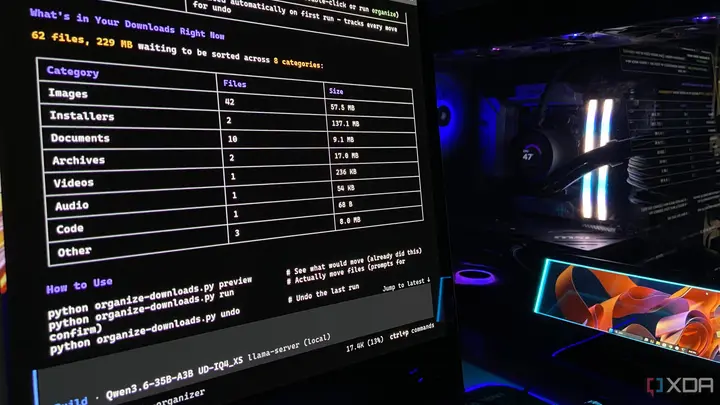
According to a first-person report on XDA Developers, a writer used a local coding agent to build a tool that sorts a cluttered Downloads folder on a Windows PC. The writer gave one instruction and no follow-up questions. The agent ran on the writer's own graphics card, so the work stayed on the desktop. The article is one writer's account, not an independent test.
The desktop has an RTX 4070 Ti Super with 16 GB of memory, a Ryzen 5 7600X and 32 GB of DDR5 RAM. The writer ran Qwen3.6-35B-A3B, an open-weight model released under Apache 2.0, in a compressed form from Unsloth. llama.cpp served the model with a 128K context window and sampling settings that Qwen recommends for coding. The agent harness was OpenCode, a free and open-source coding tool that runs in a terminal. The model has about 35 billion parameters in total, with roughly 3 billion active for each token.
The prompt asked for a tool that sorts the Downloads folder and keeps it sorted. The rules were strict. Nothing could be deleted. The agent had to show what would move before anything moved, and the user needed a way to undo changes. The tool had to work offline. The writer asked the agent not to run the real job, leaving that to the writer, and to make its own decisions without questions.
The writer timed the build at a little over two and a half minutes. The agent checked the project folder, confirmed that Python 3.12 was installed, and wrote a single script that relies only on Python's standard library, so it needs no internet connection. It also added documentation and a short launcher, letting the user start the tool with one typed word. Files are sorted by extension into fixed groups: documents, pictures, videos, sound, archives, installers, source code, fonts, subtitles, disk images, and a catch-all group. Only loose files at the top of the folder are moved, so existing subfolders are left alone. A name clash never overwrites a file; a numbered suffix is added. Every move is recorded in a log that the undo command reads.
The agent tested the script in read-only and preview modes, so nothing moved during its checks. The preview grouped 62 loose files into eight folders, with 42 images making up most of them. The agent's summary presented the result as a finished product.
The writer then asked Claude to review the code before using it on real files. According to the article, Claude ran the run and undo modes on a throwaway folder. It found a bug: the script read each file's size after the file had already been moved, which caused an error on every file. The first version also left out the ongoing sorting part of the instruction. Claude fixed the undo log and added a watch mode that sorts new downloads once they finish. Unfinished Chrome downloads, marked with the .crdownload extension, are left in place.
The writer's conclusion is that a script that looks finished still needs testing before it touches important files, whether by a second model or a trial run in a throwaway folder. The writer says the organizer now saves time that used to go on moving files by hand. The results come from one user on one PC, so speed and outcomes may differ elsewhere.
Enjoying this? Get the AI brief
Every Thursday: AI that matters for your home.
✓ Free · seven editions · one click to leave
Original reporting by the sources above. Summary by smart-home.space.