GadgetsNews wire, Yesterday
MSI EdgeMesa N AI+: 128GB RTX Spark mini PC for local AI at $7,499
Reported by How-To Geek, Tom's Hardware
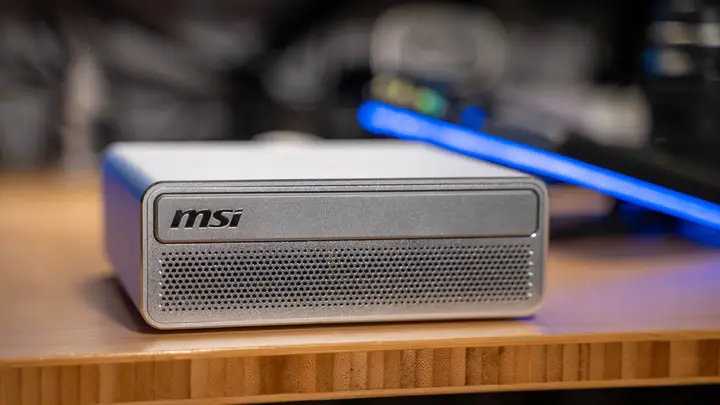
MSI has launched the EdgeMesa N AI+, a small desktop built on Nvidia's RTX Spark platform and aimed at running AI models on your own hardware. Two reviews, from How-To Geek and Tom's Hardware, tested the mini PC. Both find strong local AI performance, but both also find the price high and the design limited.
The machine has a chassis of about 1.2 litres. It uses a 6144-core Blackwell GPU and a 20-core Arm CPU. The tested version has 128GB of unified memory and 4TB of storage and costs $7,499. A second version has 64GB of RAM and 1TB of storage, and How-To Geek gives its starting price as $4,399. How-To Geek lists B&H Photo, Micro Center and MSI's own website as places to buy it.
The rear panel has a 10 Gigabit Ethernet port, an HDMI 2.1 port and three USB-C ports at 20Gbps with DisplayPort Alt Mode. A fourth USB-C port takes the 240W power adapter. Wi-Fi 7 and Bluetooth 5.4 are built in. Tom's Hardware says the rear USB-C ports sit close together, which makes frequent swapping of card readers and external SSDs awkward. It also notes there is no front USB-C port and no headphone jack, so audio needs a USB headset, a DAC or Bluetooth earbuds.
Neither version has USB4 or Thunderbolt. The EdgeMesa also lacks the ConnectX networking card that lets DGX Spark systems link together to run larger models. Both reviews treat this as a real limit for anyone who wants to grow their local AI setup later.
How-To Geek's reviewer used the machine as a headless server for a week and moved all of his local AI work onto it. It ran two models at the same time. Qwen3.8-27B served as the main agent, and the faster Qwen3.6 35B-A3B handled Home Assistant integration and simpler chat tasks. The GPU could hold an 88GB model fully in memory. The reviewer said the system beat his Strix Halo machine once the CUDA software path was used, while the Vulkan comparison favoured Strix Halo.
Speed is moderate rather than fast. The unified memory has roughly 300GB/s of bandwidth, compared with about 1.8TB/s on an RTX 5090. In benchmarks the reviewer saw about 30 to 50 tokens per second on the larger models. In real agent calls through LM Studio, the rate fell to around 23 tokens per second. Tom's Hardware also reports solid results for language models and image generation, in line with what Nvidia's GB10 platform has shown in other systems.
The How-To Geek reviewer also used the EdgeMesa for video editing. It rendered a 15-minute 1080p video in about seven minutes, a speed similar to his Strix Halo machine, and his main desktop stayed free during the work. The edit was driven by a cloud model, and he hopes to move that step to an offline model later.
On software, the EdgeMesa runs Windows on Arm. Tom's Hardware describes a familiar Windows 11 experience with broad app compatibility. How-To Geek warns that Windows on Arm limits some apps and games, and that the RTX Spark cannot run Linux officially. Tom's Hardware says gaming needs patience to tune well.
The two reviews disagree on the overall verdict. How-To Geek calls the machine brilliant as a headless AI server and frustrating as a daily desktop. Tom's Hardware sees it as a sensible choice for someone who wants an AI-capable Windows desktop and does not need clustering. It argues that most readers already have a Windows PC or Mac that can work with a DGX Spark through Nvidia's Sync app. Tom's Hardware points to MSI's own EdgeXpert, which has the same 128GB of memory and 4TB of storage. It says that unit is on sale for $8,099, against a full price of $8,499. The EdgeXpert keeps the clustering option.
Tom's Hardware also compares the price with a Mac Studio at a similar cost, which has four Thunderbolt 5 ports at the back, two more USB-C ports and an SD card reader at the front.
Several points remain unclear. The excerpts give US dollar prices only and no shipping dates or prices in other regions. Tom's Hardware reports its tested unit at about $7,500, while How-To Geek gives $7,499. Neither excerpt says how the machine performs over a long period of daily use or how it handles heavy loads for many hours.
Enjoying this? Get the Gadgets brief
Every Monday: the gadgets worth your money.
✓ Free · seven editions · one click to leave
How each source covered it
Original reporting by the sources above. Summary by smart-home.space.