GadgetsNews wire, 17 h ago
Netgear Nighthawk RS150: a budget Wi-Fi 7 router with solid range and cool running
Reported by Tom's Guide
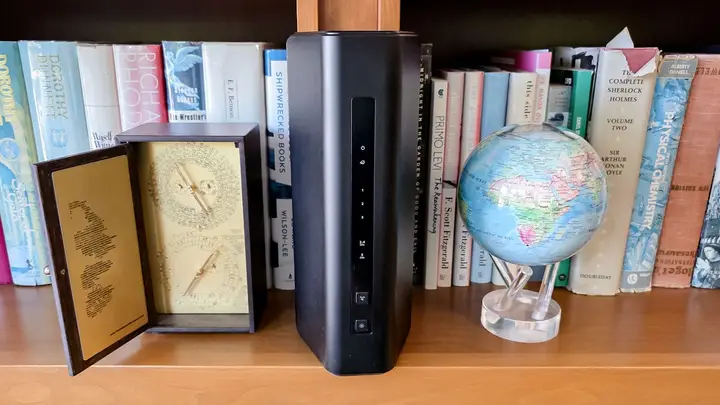
Tom's Guide has reviewed the Netgear Nighthawk RS150, a dual-band Wi-Fi 7 router aimed at buyers who want a modern home network without paying for a top model. The reviewer says the device is not the fastest in its class and does not have the longest feature list, but describes it as good value at its price.
The router has a list price of $200 and is sold online for $180. The reviewer compares it with the TP-Link Archer BE3600, which costs about $120 and was named the 2025 Editor's Choice, and with the cheaper Nighthawk RS90, which can be found for closer to $100. The RS150 is rated BE5000. It supports the 2.4 GHz and 5 GHz bands, but not the 6 GHz band, and it does not use Multi-Link Operation.
The hardware is modest. The router has three antennas, a Broadcom chip, a quad-core 2.0 GHz processor, 1 GB of memory and 512 MB of storage. Its wired ports are one 2.5 Gbps WAN port and three 1 Gbps LAN ports. It has no USB port for a data drive, unlike the Archer BE3600. The reviewer says most people will not miss the fourth LAN port, and suggests adding a network switch if more wired connections are needed. The device uses passive cooling, and its top temperature stayed at about 87 degrees Fahrenheit under load, while the reviewer says rival models ran about 20 degrees hotter.
Netgear Armor security uses Bitdefender software and includes a 30-day trial. After the trial, the standard plan costs $100 a year. It adds virus scanning for connected devices, dark web monitoring, and analysis of traffic for malicious sites and unauthorised access. It also extends the one-year warranty to three years, with service and support. Without the plan, support ends after 90 days. The Armor Plus plan costs $150 and adds a VPN that supports WireGuard and OpenVPN, along with anti-tracking and ad blocking.
In testing over several weeks of daily use, the reviewer used the Keysight IxChariot benchmark, set to mimic 10 high-performance users, with an HP notebook as the test client. Next to the router, the connection reached 1.467 Gbps, which the reviewer says is 15 per cent faster than the Archer BE3600's 1.234 Gbps. Over a 15-foot Cat 7 cable, it reached 1.527 Gbps. At 15 feet wirelessly, it measured 1.437 Gbps. At mid range, speeds varied. The average at 50 feet was 1.057 Gbps, but throughput fell to 440.8 Mbps at 75 feet and 44.7 Mbps at 90 feet. The test client never lost its connection, though speeds fluctuated. The rated range is 115 feet. Through a wall, across a 20-foot room, the router reached 1.259 Gbps.
Power use is low for this class. The router draws 9.0 watts and has no power-saving idle mode. If it runs all the time, the reviewer estimates the yearly electricity cost at $13.80, based on an assumed average electricity rate. That is about two dollars more than the Archer BE3600's estimate of $11.80.
Setup was simple. The reviewer used the Nighthawk app on a Samsung Galaxy S25, scanned the router's QR code, set a network name, password and admin login, then answered two challenge questions and verified an email address. The router connected on the first attempt, and setup took just over 11 minutes. The text we received stops during the configuration section, so we do not report further settings. Readers should check the full review for any details about the app's options and the router's other features.
Enjoying this? Get the Gadgets brief
Every Monday: the gadgets worth your money.
✓ Free · seven editions · one click to leave
Original reporting by the sources above. Summary by smart-home.space.