GadgetsNews wire, 7 h ago
Samsung R95H RGB LED TV review: strong colour and matte screen, but some crosstalk
Reported by The Verge
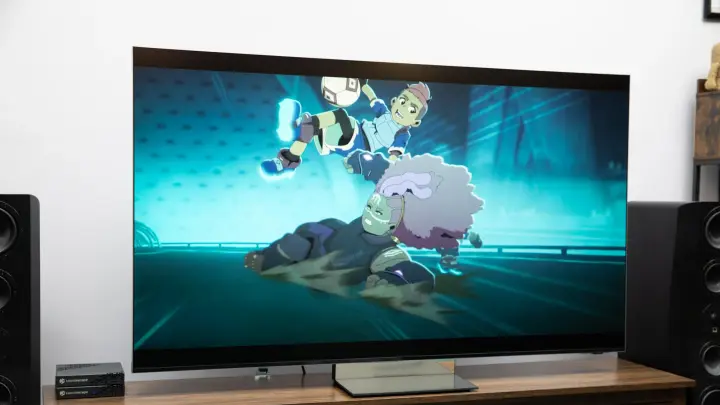
A hands-on review of the Samsung R95H, reported by The Verge, puts one of the first affordable RGB LED televisions under close test. RGB LED sets became cheaper in 2026, and the reviewer says this model delivers several of the benefits the technology promises. The test used a 65-inch unit running firmware 1247. An earlier sample had shown weaker colour accuracy, and Samsung replaced it.
The main difference from ordinary LED TVs is the backlight. Instead of white or blue LEDs behind a colour filter, RGB sets use separate red, green and blue LEDs. This lets them show more colours. The R95H covers the P3 colour space used by most films, and it also reaches the wider BT.2020 space used by only a few titles. In Filmmaker mode, HDR colour accuracy was described as good. SDR looked less accurate, because the set overbrightens many colours.
Brightness was measured at 694 nits for a full white screen and 2,206 nits for specular highlights in Filmmaker mode. That places the R95H close to the Sony Bravia 7 II, a few hundred nits below the Bravia 9 II and well behind the TCL X11L. The reviewer notes that OLED flagships usually have brighter highlights but dimmer full white screens, so the comparison is not one-sided. Black levels were rated very good for an LED display, with some blooming around bright objects, less than on several other RGB sets tested this year.
The matte screen is a major strength. It limits reflections from ceiling lights, and the reviewer was not distracted by them, unlike with glossy panels. Black levels rise a little in a bright room because ambient light is caught behind the coating, but the picture keeps its depth. For gaming, the set ran smoothly at 120Hz in a racing title. At 60Hz on an Xbox the motion was less steady, though still playable. Earlier reviews had reported smearing, and recent firmware appears to have reduced it for the most part.
The main drawback is colour crosstalk. When a strong colour sits next to a lighter one, such as white text on a red news ticker, the dominant colour can tint the light area. The reviewer saw this on the R95H, most clearly with white text. The effect was least visible on the Sony Bravia 9 II. Some TVs avoid the issue by using a white backlight, but that reduces colour brightness and gamut. Buyers therefore face a trade-off between crosstalk and colour range.
Software and features have limits. The set does not support Dolby Vision, although it supports HDR10 Plus. It runs Samsung's Tizen system, where common options such as input selection sit several menu levels deep. The remote charges through USB-C and through solar panels on its back. The buttons are bunched together, and the volume control was described as clunky.
On price, the review says the R95H costs more than most rivals. The Bravia 9 II gets an edge from its processing and brightness, though it shows more blooming. For a 75-inch screen, the TCL X11L is much cheaper, and the reviewer considers it the better overall TV. Samsung's S95H and the LG G6 OLED cost about the same as the R95H or less, depending on size. OLED keeps an advantage in overall picture quality because of its stronger contrast.
The sources do not give the exact list price or regional availability of the R95H, and the review does not cover long-term reliability. Readers should check local retailers and current pricing before buying.
Enjoying this? Get the Gadgets brief
Every Monday: the gadgets worth your money.
✓ Free · seven editions · one click to leave
Original reporting by the sources above. Summary by smart-home.space.