AINews wire, 2 h ago
Gemini Live comes to Android Auto: what drivers need to know
Reported by Android Police
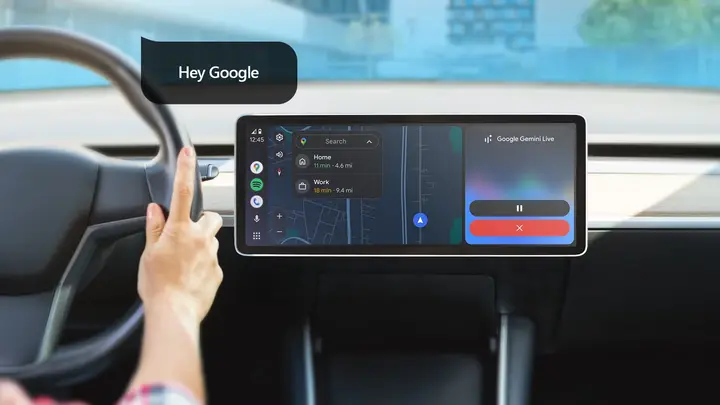
Google has added its Gemini Live assistant to Android Auto, the system that shows phone apps on a car's infotainment screen. Ben Khalesi, writing for Android Police, describes using it on his daily commute to debate chosen topics with the assistant. The report presents this as a more useful use of drive time than podcasts or music, but it also stresses caution while behind the wheel.
To use the feature, the phone must run Android 11 or newer and have at least 2GB of RAM. Gemini also has to be set as the default assistant. Once the phone connects to the car, the driver presses the voice button and asks to start a live chat. Gemini Live opens in a small panel, so the map on the car screen stays fully visible.
Google has also released Personal Intelligence for Android Auto, limited to users over 18. It lets Gemini reach connected apps such as Gmail, Google Calendar and Maps. According to the report, this gives the assistant more personal material to use in a debate. Google plans to bring the same features to cars with Google Built-In in the coming months. The report notes that this feature is not available in the European Economic Area, the UK or Switzerland.
The author's main advice is to shape the assistant's behaviour with specific prompts. A broad request for an overview of electric cars gives a pleasant summary, while a request to take a firm position and challenge each point gives a real argument. Asking for a lecture on a historical period gets a long monologue, whereas a short explanation followed by a quiz works better. Asking Gemini to play a role, such as a skeptical interviewer who waits for answers and points out weak logic, also works well.
The report also warns that Gemini can be wrong and still sound confident. The author explains that the model predicts likely next words from its training data, so its claims need checking. When it wants to support a point, Gemini may produce invented facts, including made-up history or figures. The author still finds the arguments useful and says that not everything the assistant says is false.
Driving safety is the main caution. The author argues that a debate needs far more attention than a podcast, and that tracking road conditions and hazards competes with holding an argument together. The advice is to end the conversation when traffic becomes dense, because a distraction at that point is dangerous.
The report does not give a date for wider rollout to other car systems, and it does not say how the feature will work in the regions where it is currently unavailable.
Enjoying this? Get the AI brief
Every Thursday: AI that matters for your home.
✓ Free · seven editions · one click to leave
Original reporting by the sources above. Summary by smart-home.space.