EnergyNews wire, 1 h ago
Hybrid solar module cools cells and heats water, lab tests show
Reported by pv magazine
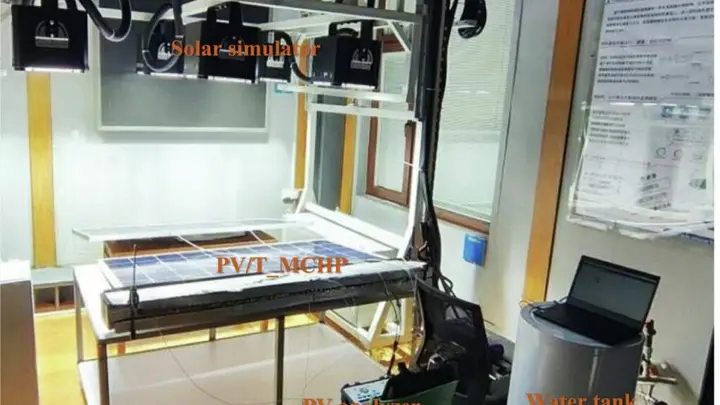
Researchers at the University of Nottingham in the UK and Shandong Jianzhu University in China have built a hybrid solar module. It cools a solar panel with a microchannel heat pipe, a sealed tube that moves heat away from the cells, and it passes the recovered heat to water. The design is described in a study published in Applied Thermal Engineering.
The team first built a numerical model in MATLAB. It simulates heat flow through the panel, the heat pipe and the water manifold, including refrigerant evaporation, condensation and return. The model also subtracts the electricity used by the pump to find net output. The researchers then built a prototype by bonding a commercial 210 W polycrystalline panel to a flat heat pipe. The refrigerant was R141b. Water circulated through a manifold on the condenser side and a storage tank.
In indoor tests under a solar simulator, irradiance ran from 200 to 940 W/m². Ambient temperature was held at 37 C and water inlet temperature at 35.5 C. At 940 W/m², the module kept the cells at 67.66 C, while a conventional panel reached 83.13 C. Electrical efficiency was 11.15 percent for the hybrid module and 10.18 percent for the conventional panel. Across the irradiance range, average electrical, thermal and weighted overall efficiencies were 11.87%, 47.10% and 73.71%.
The parameter study found that electrical efficiency falls as the water inlet temperature rises. It rises with water flow up to 0.2 m³/h, then drops at higher flows, while thermal gains level off past that point. A longer heat pipe improves cooling and thermal output, but the gains shrink beyond a ratio of 0.22. The combination of that ratio and 0.2 m³/h gave the reported weighted overall efficiency of 78.94%.
Several points are still unknown. The results come from a lab prototype tested under simulated sunlight, not from an installed system outdoors. The study does not report cost, lifetime or a commercial timeline. The researchers describe the approach as promising for solar energy use, but no product or supplier is named.
Enjoying this? Get the Energy brief
Every Friday: prices, subsidies and what changed in your market.
✓ Free · seven editions · one click to leave
Original reporting by the sources above. Summary by smart-home.space.